

BRAZIL ---------------------------------------------------------------------------------------------------------------------------------------------------------------
Of all the different markets and countries around the world where the NES was sold, none are more interesting or confusing than Brazil. Due to very high tariffs on imported electronic goods, Nintendo was unwilling to sell their products in Brazil during most of the NES era. Nintendo's biggest rival at the time, Sega, was not as strict about who could manufacture their products and partnered with Brazilian company Tec Toy to build and sell their 8-bit console - The Sega Master System. This eliminated the tariffs and resulted in the Master System becoming the dominant console in Brazil. It was a huge win for Sega since they never captured above 10% of the home video game console market in the United States when competing with the NES. But just because the NES was not for sale in Brazil did not mean that the people didn't want it, and there were a lot of companies that seized the opportunity to make their own NES and Famicom
clone consoles and game cartridges. Much like Sega, Atari consoles had been manufactured and sold in Brazil for many years prior, so making video games was something a lot of companies there were already pretty good at doing. In one format or another a large percentage of the entire NES/Famicom library of games were sold as bootleg copies in Brazil long before the NES finally arrived officially in 1993. Some games such as Fighting Hero, Crime Busters, Brush Roller, and Fire Dragon could only be found in the 72-pin NES format in Brazil. This page will attempt to make sense of the official NES release in Brazil, as well as the main companies that produced NES-compatible bootleg (and in some cases licensed) games for the wide variety of console options Brazilians had to choose from.

Sega Master System
by Tec Toy
PLAYTRONIC ---------------------------------------------------------------------------------------------------------------------------------------------------------
In keeping with the confusing nature of the NES in Brazil, we'll start at the end of the story. One of the main companies that designed, produced, and sold a 72-pin NES-compatible clone system was a large electronics company called Gradiente. They did this after meeting with Nintendo and having their proposal to bring the NES to Brazil rejected. The Phantom System console was launched shortly thereafter in 1989 and it wasn't until 1993 that Nintendo, Gradiente, and toy company Estrela finally made a deal and officially launched the NES in Brazil under a newly-formed company called Playtronic.
Because Brazil's PAL-M TV format is compatible with the NTSC format used in the USA, all 73 games released under the Playtronic brand are nothing more than the USA games with either their front, back, or both labels replaced. Like every regional NES market, there are some unique console and hardware packaging variants to be found in Brazil. For example, unlike the USA Power Set that included the Zapper light gun and the Power Pad, the Power Set in Brazil was the equivalent of the USA Challenge Set (console and 2 controllers) with either Super Mario Bros. 3, Kirby's Adventure, or Super Spike V'Ball/Nintendo World Cup as the pack-in game. Another notable Playtronic offering was the Power Pad with World Class Track Meet and Dance Aerobics both packed-in. The most infamous Playtronic variant however is Super Spike V'Ball/Nintendo World Cup in the gold cartridge. That's right, the same special shiny gold cartridge that was only used for the two Zelda games was also used in Brazil for this random 2-in-1 cart. And just for fun, there are two variants of it - one with the Playtronic label, and one with the USA label.

Power Pad by Playtronic
with World Class Track Meet
and Dance Aerobics

Power Set by Playtronic
with Super Mario Bros. 3

Super Spike V'Ball /
Nintendo World Cup
Gold Cartridge &
Playtronic Label
All of the Playtronic NES games came in a unique Playtronic box with a black & white Playtronic manual. Every game has the back label replaced, but only 21 of the 73 games have a new Playtronic front label variant. The rest have the USA front labels. The Playtronic front labels all have a blank red stripe across the top, the Playtronic logo, an Oval R SOQ, and no ID Code. World Class Track Meet was only sold as a pack-in game and did not have the front or back label replaced, making it unique in that it does not have a Playtronic cart variant even though it was sold in Brazil. Finally, 9 of the games have their titles translated to Portuguese, but only on the box and manual, not on the cart labels. The chart below lists all of the Playtronic NES games and their variant info.

Playtronic Back Label &
Serial Number Sticker

Tetris 2
Playtronic Box

Commando
Playtronic Label

Super Spike V'Ball /
Nintendo World Cup
Playtronic Manual


In order to correct the color differences between NTSC and Brazil's PAL-M TV format the Playtronic NES consoles have an additional circuit board attached to the NES motherboard that handles the PAL-M video encoding. This was obviously a lot less expensive than manufacturing an entire new library of games for Brazil. The board is part number NES-BRA-01.

NES-BRA-01
PAL-M Video Encoder
Gradiente ------------------------------------------------------------------------------------------------------------------------------------------------------------
Gradiente is a very large Brazilian electronics company that was founded in 1964. It has had many subsidiary companies, and arguably played the largest role in shaping video game history in Brazil. In 1983 Gradiente officially brought the Atari 2600 to Brazil via it's subsidiary Polyvox. Their next console release was going to be the Atari 7800, but what Gradiente really wanted was to sell the NES. At that time Nintendo was

already dominating the North American market, and The Sega Master system was leading the way in Brazil. The Atari 7800 seemed like a loser, so Gradiente reversed-engineered the NES to show that it could be made by them in Brazil and took their idea to Nintendo in 1989 with hopes of securing an official partnership. When Nintendo ultimately declined, Gradiente decided to use their prototype machine to launch their own 8-bit console - The Phantom System. If the hardware looks familiar it's because the console is an Atari 7800 shell, and the controllers and light gun are copied designs from the Sega Master System. The Phantom System is fully compatible with NES and Famicom game cartridges (via a 60-pin adapter) and, while it is a direct copy of the NES, was legal in Brazil since Nintendo held no patents and did no official business there. Gradiente even went so far as to license a handful of the same games made for the NES by some of Nintendo's 3rd-party
Phantom System
by Gradiente
publishers. However, if Gradiente wanted to maintain the legitimacy of their console and keep hopes alive of someday securing the Nintendo partnership what they could not afford to do was to produce and sell the most popular 1st-party NES games like Super Mario Bros. and Excitebike. These were of course the best-selling titles, and some of Gradiente's competitors were already selling bootleg versions of them. So what did Gradiente do? They sold re-named bootleg copies of the games, marketed specifically for play on the Phantom System, under new shell companies called Falcon Soft and Winner Game. Finally, in 1993 Gradiente and Nintendo, in partnership with toy company Estrela, made a deal to bring the NES to Brazil under a new company called Playtronic. Unfortunately by then the NES was at the end of its lifecycle and Playtronic also brought the Super Nintendo to Brazil. But even so, the NES was sold in Brazil for a few years and the Playtronic games live on with collectors as a very fun and challenging set of games to find.

Crime Busters
by Gradiente
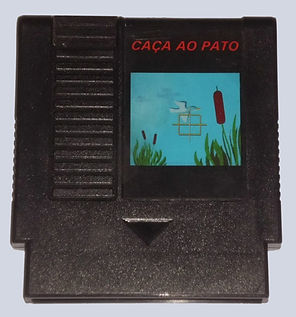
Caca ao Pato (Duck Hunt)
by Falcon Soft

Super Irmaos (Super Mario Bros.)
by Winner Game
Milmar ----------------------------------------------------------------------------------------------------------------------------------------------------------------
Milmar Electronics got its start selling Atari 2600 clones to compete with Gradiente's Polyvox Atari 2600. During the NES era they released the Hi-Top Game NES clone console along with a line of games previously released by Sachen and American Video Entertainment. The Hi-Top Game console had three versions, first with joystick controllers and later with controllers in a more standard NES format. The Milmar games have a black cartridge with rounded top similar to the Gradiente Phantom System games. However some copies of the Milmar AVE games can be found in the AVE cartridges with a modified front label, Milmar back label, and Milmar company info stamped onto the cart back. The most notable game from the Milmar catalog is Futebol, which is a ROM hack of Ultimate League Soccer by AVE which replaces all of the teams with Brazilian clubs. Milmar went on to release the Top System in 1994 which had dual 60-pin and 72-pin cartridge slots, but by then the 16-bit video game consoles had taken over and Milmar got out of the video game business shortly after.

Milmar Hi-Top Game Console

Milmar Top System Console

Futebol
Milmar Cartridge


Double Strike
Milmar AVE Cart Back
CCE ---------------------------------------------------------------------------------------------------------------------------------------------------------------------
One of the more complicated video game publishers to figure out in Brazil is CCE (Comércio de Componentes Eletrônicos). Like several of its competitors CCE was an electronics manufacturer that got its start in video games by manufacturing clone consoles of the Atari 2600. The CCE Top Game console was one of the most popular systems in Brazil, largely due to the fact that it was the first console to have both 72-pin and 60-pin game ports, giving it the ability
to play both NES and Famicom games without an adapter. CCE also released a very popular follow up to the Top Game called the Turbo Game, which was the same system but with controllers that had turbo buttons. Because their hardware could play both types of cartridges, CCE released a lot of games in both formats. They also had different lines of games that were marketed in different ways. Some were branded to match their consoles, others were more generic and labeled simply as being NES compatible. Some CCE games came in hard plastic clamshell cases, and others came

CCE Top Game Console
packaged in a blister pack (plastic bubble glued to a cardboard backing). Some CCE games had unique game-specific labels, and other had generic labels with stickers applied to identify the game. The entire CCE catalog can be divided into 3 categories of games, based on how they were marketed, packaged, and sold. There are variations of cartridge types within those categories that are described below. One thing that is consistent across all of the CCE games is the use of a catalog number system starting with "C7". Some of the games only have this code on the box, where others have it on the front label.
CCE Audax
CCE Turbo Game
CCE Vic Turbo Game
The CCE Audax line of games has the most titles. They were sold in 72-pin and 60-pin cartridges, and packaged in a generic blister pack. The NES carts are a copy of the licensed 3-Screw design in black plastic. They feature a generic label with a rectangular sticker applied that identifies the game and the catalog number.
The CCE Turbo Game line of games was marketed directly for the CCE console systems. They came packaged in a hard plastic clamshell case and exist in three different cartridge formats: A 3-screw black cart like the Audax line above, a 3-screw blue cart, and a 4-screw rounded blue cart.
The Vic line of CCE Turbo Game releases is exactly the same as the regular Turbo game releases above, with the addition of the "Vic Video Game" logo on the games' packaging and labels. There is also a 4th cartridge variant in the Vic line of games which is another 3-screw shell made in a dark blue/purple color.

Batman
C7-1122
CCE Audax Cart

Double Dragon II
C7-1115
CCE Turbo Game
3-Screw Black Cart

Super Mario Bros. 3
C7-1121
CCE Turbo Game
3-Screw Blue Cart

Fighting Hero
C7-1401
CCE Turbo Game
4-Screw Rounded Blue Cart

Goal!
C7-1700
CCE Vic Turbo Game
3-Screw Dark Blue Cart
DISMAC ---------------------------------------------------------------------------------------------------------------------------------------------------------------
Dismac Industrial, S.A. was founded in Brazil in 1973 and became the country's largest manufacturer of calculators, among other electronic devices, before entering the video game market with their model VG8900 Atari 2600 clone. This console curiously featured the Activision logo, though neither the console nor Dismac had any affiliation with Activision. This was seemingly the beginning of what would become Dismac's long history of video game bootlegging. In 1989 Dismac became the first company in Brazil to release a 72-pin NES clone console - The Bit System. It was considered to be one of the higher-quality NESclones developed in Brazil, and was unique in that it used the same controller ports & plugs as the actual NES. The Dismac games come in several different cartridge variations, but are easily identified by a sticker on the back with Dismac's name and company info in the space where Nintendo's logo is molded into licensed carts. Dismac games exist in 5-Screw and 3-Screw black and gray carts, as well as a few titles in a unique white cart that is not found anywhere else.

Dismac Bit System Console

Super Mario
(Super Mario Bros.)
Dismac 5-Screw Black Cart

Super Contra
(Contra: Super C)
Dismac 5-Screw Gray Cart

1942
Dismac 3-Screw Black Cart

B-Wings
Dismac 3-Screw Gray Cart

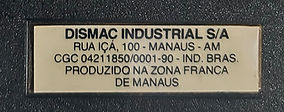
Dismac Cart Back Label
Crime Busters
Dismac White Cart
CONECTOR (NTDEC) -----------------------------------------------------------------------------------------------------------------------------------------------
It should come as no surprise to anyone familiar with unlicensed NES games that NTDEC was selling bootleg games in Brazil. While they did not have their own console, they did have a very large library of games including some 2-in-1 and 4-in-1 multicarts. As is typical with NTDEC, there isn't much info available about their business in Brazil other than the fact that they were operating under the name Conector out of São Paulo, as indicated on the games' labels. The Conector games feature 1 of 6 generic artwork front labels, and a label on the back containing the name of the game(s) and a catalog number. Like the Gradiente and Milmar games, the Conector cartridges feature a rounded top where the front label wraps around and has the NTDEC logo on the spine.

Soldier Label
Conector NTDEC

Sports Label
Conector NTDEC

Ghost Label
Conector NTDEC
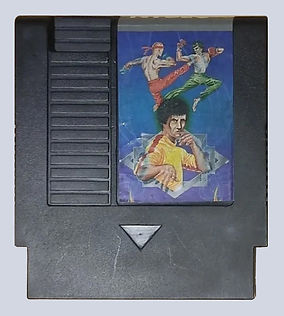
Martial Arts Label
Conector NTDEC

Robot Label
Conector NTDEC

Fighter Jet Label
Conector NTDEC

NTDEC Top Spine Logo

Back Labels
Conector NTDEC
INTERATIVE (CHIPS DO BRASIL) --------------------------------------------------------------------------------------------------------------------------------
Chips do Brasil is yet another Brazilian electronics company, this time specializing in telephones and related devices, that entered the booming video game market in the 1990's. They released a series of 60-pin and 72-pin games under the brand name Interative and eventually came out with their own 72-pin NES clone console, the Prosystem-8, in 1994. Designed to look like the Super Famicom, the Prosystem-8 was an imported Asian system that existed in dozens of variations all over the world. Initially the games were packaged in cardboard boxes, but later were upgraded to plastic clamshell boxes to more closely mimic the popular Sega Master System games. Unfortunately for them, Chips do Brasil entered the market after Playtronic began selling official Nintendo products in Brazil and were repeatedly sued and driven out of business by 1998.

Chips do Brasil Prosystem-8 Console

Fire Dragon
Interative (Chips do Brasil)
DYNACOM ------------------------------------------------------------------------------------------------------------------------------------------------------------
When it comes to video game history in Brazil, one of the most important and influential companies is DyanCom. Founded in 1981, DynaCom started out making clones of the Atari 2600 and Apple II personal computer. In 1989 they were the first company in Brazil to produce a Famiclone console, the Dynavision 2, which came with joystick controllers. Throughout the 1990's they would follow this up with different versions of the Dynavision 3 and Dynavision 4 systems, which all feature dual 60-pin and 72-pin game ports and eventually more standard D-Pad controllers modeled after the ones found on the Sega Master System. DyanCom has a massive library of 60-pin games but interestingly only ever released one 72-pin game. That game is none other than Multi-Ação 6 In 1, aka Caltron 6-In-1. Unlike most of its competitors, DynaCom managed to survive beyond the 8-bit video game era in Brazil, and continued making new products until it finally went out of business in 2011.

DynaCom Dynavision 4 Radical Set Console

Multi-Ação 6 In 1
DynaCom
HYDRON --------------------------------------------------------------------------------------------------------------------------------------------------------------
Possibly the coolest and most mysterious series of games sold in Brazil is the Hydron carts. According to the back label of the game they were produced in Brazil by Divertil LTDA. There is no record of this company to be found anywhere. There is also no definitive list of all the Hydron games that were produced. Aside from being very rare, what makes these games special is that they are the only know cartridges in the world that have a 72-pin connector on one end, and a 60-pin connector on the other end. This allows them to be played on any of the clone systems without the use of an adapter. The cartridges feature a generic front label with three intertwined 2-headed dragons that looks exactly the same no matter which side is facing up. The game is identified on one of the two back labels. Some Hydron games are either 2-in-1 or 4-in-1 multicarts. Hopefully someday more information about these games will surface, but for now that's all there is to know.

Captain Skyhawk
Hydron Cartridge Front

Captain Skyhawk
Hydron Cartridge Back
MANIA (MAGIC TOYS) ----------------------------------------------------------------------------------------------------------------------------------------------
Little-to-nothing is known about the Mania games by toy company Magic Toys. They all have a generic front label featuring a joystick controller and racing game, and a separate spine label with the name of the game on it. The Mania games can be found in gray, black, and white cartridges. Magic Toys is still in business and primarily makes toys for very young children. I've reached out to them in an attempt to get some info on these games, but so far no response.

Os Esquilos
(Chip 'N Dale Rescue Rangers)
Mania Gray Cart Front

Mania Black Cart Back
TECMAGIC - FANTASY GAME -------------------------------------------------------------------------------------------------------------------------------------
Tecmagic was a Brazilian electronics company that started out manufacturing antennas and made an attempt to enter the video game market by making bootleg multicarts for the Atari 2600. They also apparently made some NES bootleg carts, though little is know about them and they are hard to find. There is another equally obscure series of games in Brazil that are labeled Fantasy Game. They have very similar cartridges and packaging as the Tecmagic games, and also feature the same unique catalog number system on the back label starting with "cod.". It's for this reason that I'm assuming the Fantasy Game carts are just another branding of the Tecmagic games. This seems to be the prevailing wisdom among Brazil collectors that I've spoken to, so as much as I hate to guess at anything here on the site, I'm sticking with this for now. If anyone has better info on either of these series of games please email me.

Tecmagic Cartridge Front

Fantasy Game Cartridge Front

Mach Rider
Tecmagic Cartridge Back

Road Fighter
Fantasy Game Cartridge Back
LISTS OF CONSOLES & GAMES -----------------------------------------------------------------------------------------------------------------------------------
In this last section on Brazil I'm going to keep a list of all of the clone consoles and games I can find evidence of. These lists are by no means complete, and will likely be updated on a regular basis, forever. If you have anything in your collection that isn't listed here please email me so I can add it to the site.

